Drift Racer: Real Car Driving
- 4.6
- Rating
- 1.00M
- Installs
- Free
- Price
 Analysis by App-foxy
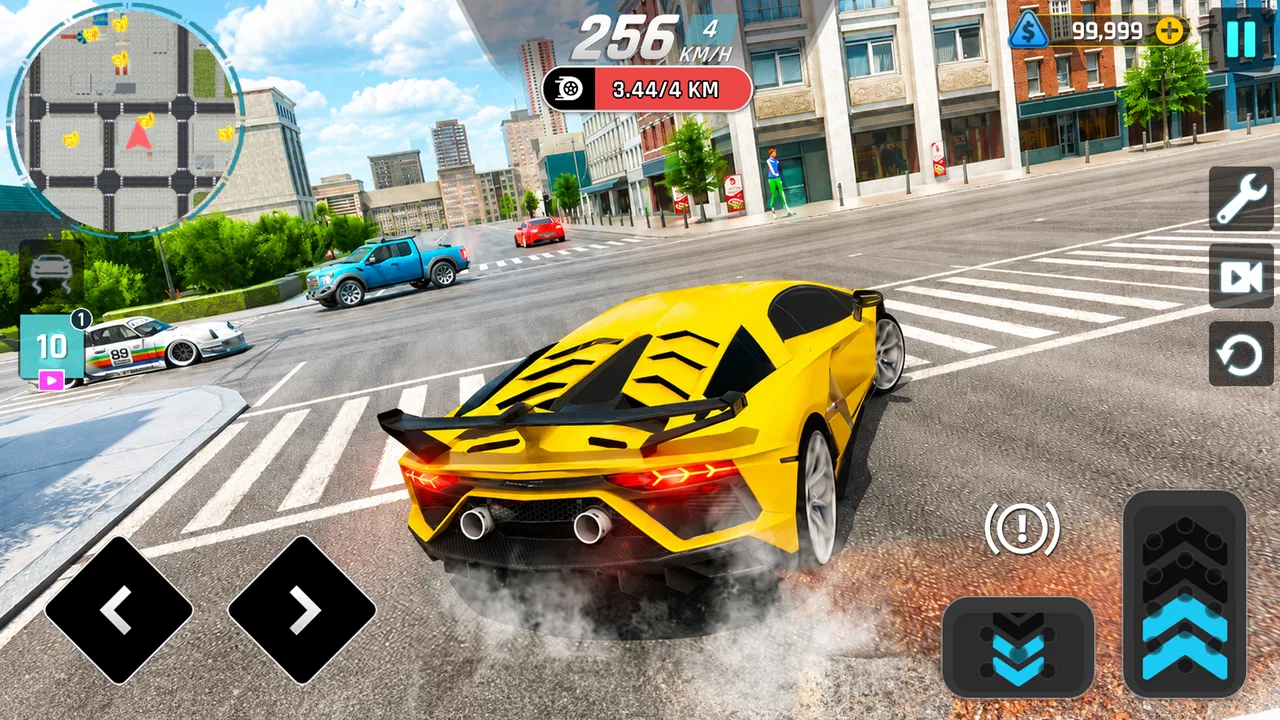
I approached Drift Racer: Real Car Driving as a quick way to enjoy open-world driving rather than as a strict competitive racer. Its appeal is easy to understand: you get behind the wheel, look for room to move, and turn ordinary driving into a chance to practise slides and control. The game is free, rated for Everyone, and belongs to the racing category, so it is immediately approachable for younger players and casual users who do not want to commit to a complicated simulator.
My first impression was that this is best treated as a short-session driving game. The store summary presents it as a limited open-world car-driving simulation, and that wording matters. I would not install it expecting the depth of a large console-style driving game. Instead, I see it as something to open when I have a few minutes, experiment with movement, and enjoy the simple satisfaction of keeping a car under control.
That distinction helps set the right expectations. Players who mainly want a relaxed space to practise drifting may find the idea attractive, while people looking for a large career mode, detailed vehicle collecting, or a highly structured online competition should be more cautious. In my experience, the game makes more sense when judged by how quickly it lets me get into the driving rather than by features associated with much bigger racing releases.
You May Also Like

 Blood Strike: 2.5 Anniversary
Blood Strike’s Loadouts Turn Every Drop Into a Tactical Gamble
A close look at Blood Strike’s custom loadouts: how fast access to signature weapons reshapes its battle royale rhythm, rewards preparation, and narrows the gap between fights.

 Pandora - Music & Podcasts
Pandora’s Music Is Easy to Start, but Harder to Recover
Pandora’s strength is its low-effort path from a seed to a station. Its weak spot is how much confidence it asks you to place in connection, setup, and quiet recovery.

 8 Ball Pool
 Is Built on Rivalries, Rematches, and Routine
A close look at the rivalries, rematches, shared routines, and unanswered safety questions that turn a quick pool match into a persistent mobile community.

 Samsung Music
’s Quiet Strength Is Playing What You Already Own
Its reach comes less from spectacle than from dependable access to a personal library. That simplicity is both the app’s strongest retention engine and its ceiling.

 AccuWeather: Weather Radar
AccuWeather Review: A Quick, Clear Forecast for Everyday Decisions
For everyday plans, the best forecast is the one you can understand quickly. AccuWeather makes rain timing, radar, and local conditions easy to act on, with a few trade-offs.

 Hill Climb Racing
Why Hill Climb Racing Still Turns Crashes Into One More Run
A tiny car, a bumpy hill and one more upgrade: Hill Climb Racing keeps resurfacing because its simple chaos makes every near-miss feel personal.
More From Our News Desk
View All News


How I settled into the driving loop
I settled in by treating each drive as a small control exercise rather than chasing a perfect slide right away. That made it easier to notice how my steering choices affected a turn and to keep practice relaxed, especially when I only had a few minutes. With that baseline in place, I could judge the game’s appeal—and its limits—more fairly.
A simple baseline workflow works best
I recommend beginning with a short, repeatable routine instead of immediately trying to perform dramatic drifts. I start by driving normally, learning how the car responds when I turn, and noticing how much space I need before changing direction. This sounds basic, but it makes the later sliding attempts far less frustrating. When I rush straight into aggressive manoeuvres, I spend more time correcting mistakes than enjoying the drive.
My usual first session follows three steps: drive in a straight line, make broad turns, and then gradually tighten those turns. This gives me a practical feel for acceleration, steering response, and the amount of correction needed after a slide begins. I also leave enough open space around the car to separate a driving mistake from a collision with the environment. That habit is particularly useful in an open-world setting, where an unexpected obstacle can make a manoeuvre look worse than it really was.
The most useful mindset is to treat each run as a small experiment. I do not try to hold a slide indefinitely. I enter a turn, make a controlled correction, and reset if the car becomes difficult to manage. This approach produces more consistent practice than repeatedly forcing the same failed turn. It also makes the game easier to recommend to someone who has never played a drifting-focused racer.
For an everyday scenario, imagine having a short break between tasks. I can launch the game, spend a few minutes driving around, and focus on one goal such as making smoother turns. There is no need to prepare a long session or learn a complicated upgrade tree before the driving becomes enjoyable. That immediacy is one of the clearest strengths here.
What I would check before chasing better runs
The first settings I would inspect are the control options and any available sensitivity choices. I prefer to begin with a moderate steering response, because an overly sensitive setup can make small corrections feel like large ones. If the car reacts too slowly, I then adjust gradually rather than changing everything at once. This gives me a better idea of which setting actually improves control.
I also check whether the game offers different input methods, such as touch controls or device movement, before forming a final opinion about handling. A control scheme that feels awkward for one player may be comfortable for another. Touch steering can be useful when I want direct, predictable input, while motion-based control may feel more natural to someone who prefers turning the phone. The important point is to choose one method and practise with it for a while instead of switching every few seconds.
Visual settings are worth considering as well, especially on an older phone. The game supports Android devices from version 7.0 onward, which gives it a broad reach, but compatibility does not guarantee that every device will feel equally smooth. I would lower demanding visual options if available before blaming the controls for delayed reactions. Stable performance matters more to drifting than extra visual polish because a small interruption can ruin the timing of a turn.
My practical rule is to change one setting at a time and test it on the same type of turn. That simple comparison prevents guesswork. It also helps identify whether a problem comes from the steering response, the chosen input method, or the phone itself. Players often overlook this step and then conclude that a game is difficult when the real issue is an unsuitable control setup.
Repeatable patterns are more useful than flashy attempts
Once the basic controls feel comfortable, I use wide circles and gentle direction changes as my main practice pattern. Wide circles give me time to observe how the car transitions into a slide and how quickly it recovers. They are also safer than trying to drift beside walls or tight corners. After that, I move to a sequence of alternating turns, concentrating on finishing one correction before beginning the next.
A helpful habit is to look toward the exit of a turn rather than staring at the car. This encourages earlier steering adjustments and makes the movement feel less reactive. I also avoid holding the same input for too long. Short corrections usually give me more control than a single dramatic movement, especially when the car begins to rotate faster than expected.
Another useful pattern is to separate speed practice from drift practice. I first learn how the car behaves at a comfortable pace, then add speed only after I can repeat the turn. This prevents speed from hiding the real cause of a mistake. If the car leaves the intended path, I slow down and repeat the same manoeuvre instead of immediately trying to compensate with a sharper input.
These habits are not secret shortcuts, but they are the kind of small decisions that make a limited driving game more enjoyable. The game does not need a huge number of systems to reward careful practice. Its value comes from giving me a straightforward space in which small improvements are easy to notice.
Where experienced players may find the limits
The same simplicity that makes the game approachable can limit its long-term appeal. Players who expect a detailed simulation may find the driving model less demanding than a dedicated racing simulator. A player who wants a large variety of events, deep vehicle tuning, or a strong sense of progression may also outgrow it quickly. I would not choose this as my main racing game if structured competition is the most important part of the experience.
The open-world format can create a different kind of limitation. Having room to drive is relaxing, but a broad area is not automatically the same as a rich world full of meaningful activities. If I am looking for carefully designed tracks, clear objectives, or a steady sequence of challenges, a traditional racing game may give me a stronger reason to keep playing. Here, I need to bring some of my own goals, such as practising a particular turn or completing a smooth drive without unnecessary collisions.
That makes the game more suitable for self-directed play than for players who need constant direction. I enjoy this when I want freedom, but I understand why someone else might find it repetitive. The experience depends heavily on whether the act of driving itself is enough motivation.
I would also avoid judging the game only by its perfect average rating. It has a 5.0 average from around 500 ratings, which shows that its current audience has responded very positively, but ratings do not replace personal preference. A player who loves short, accessible driving sessions may be delighted, while someone seeking a feature-heavy racer can still feel that the experience is too limited.
Who should install it and who should skip it
I think this game is a good fit for casual racing fans, younger players, and anyone who enjoys experimenting with drifting without first learning a complex simulation. The Everyone age rating makes it an easy recommendation for families who want an uncomplicated driving game. It is also appealing for Android users who prefer a free download and want to try the core driving experience before spending money on a larger title.
Its reach is already substantial, with over 500 thousand installs, and that gives the game a useful sense of community interest without changing its straightforward character. The developer, SKYVERTY COMPANY LIMITED, has positioned it around the central pleasure of driving rather than around a long explanation of systems. I appreciate that focus because it lets me decide quickly whether the handling itself is enjoyable.
I would skip it if my priority is realistic vehicle behaviour, championship-style progression, or a large selection of carefully separated racing modes. I would also look elsewhere if I want a game that tells me exactly what to do during every session. A more structured racer will be a better choice in those cases. This game works best when I am comfortable creating my own small challenges.
Version, access, and what the current package means
The current version is 1.0.1, so I approach it as a relatively early release rather than a mature racing platform with years of accumulated content. That does not make it a poor choice, but it does affect how I evaluate it. I focus on whether the basic driving loop is enjoyable now instead of assuming that it already offers the breadth of a long-established alternative.
Because it is free, the entry barrier is low. I can try the controls, test the open-world driving, and decide whether the handling suits me without treating the download as a major commitment. The free price is especially useful for families or casual players who want a simple experiment rather than a premium purchase.
My advice is to give the game a focused trial. Spend the first session adjusting controls and learning the car, then use a second session to repeat a few turns. If the driving still feels satisfying after that, the game has probably found its audience in you. If it already feels empty once the novelty fades, no amount of forcing longer sessions will turn it into the deeper racer you wanted.
My verdict after using the game as intended
Drift Racer: Real Car Driving is most convincing as a compact open-world drifting experience. I like that I can begin driving quickly, practise without a long tutorial routine, and create my own goals around smoother control. The free access, Everyone rating, broad Android compatibility, and simple premise make it easy to try.
Its weaknesses are closely tied to that simplicity. The game may not satisfy players who need extensive progression, detailed simulation, or a constant stream of formal challenges. Its open space is useful for practice, but players must supply much of the structure themselves. That is a fair trade-off for a casual driving game, though it is not a trade-off everyone will enjoy.
For me, the best way to play is to keep sessions focused: select comfortable controls, practise a repeatable route, slow down when corrections become messy, and judge improvement by consistency rather than by one spectacular slide. Those habits make the available driving feel more rewarding and expose the game’s strengths without pretending it offers the depth of a full racing simulator.
Overall, I would recommend it to someone who wants a free, approachable drifting game for short sessions and relaxed experimentation. I would describe it as a starting point rather than a complete replacement for a feature-rich racing favourite. If that sounds like the experience you want, the current release is easy to try and pleasantly direct. If you need a deep career, competitive events, or advanced tuning, choose a more specialised alternative instead.
FAQs for Drift Racer: Real Car Driving
01What are the system requirements for Drift Racer: Real Car Driving?
To ensure optimal performance, Drift Racer: Real Car Driving requires Android 5.0 or later, or iOS 11.0 or later. The game is compatible with most modern smartphones and tablets, but for the best experience, it's recommended to use a device with at least 2GB of RAM and a quad-core processor.
02Is Drift Racer: Real Car Driving free to play?
Yes, Drift Racer: Real Car Driving is free to download and play. However, the game offers in-app purchases that allow players to buy additional features, cars, or upgrades. These purchases are optional and not necessary to enjoy the full gameplay experience.
03Does Drift Racer: Real Car Driving require an internet connection?
Drift Racer: Real Car Driving can be played offline, making it perfect for on-the-go gaming. However, some features like leaderboards, special events, and updates require an internet connection to function properly. Playing online also enhances the social aspects of the game.
04What features make Drift Racer: Real Car Driving unique?
Drift Racer: Real Car Driving stands out with its realistic physics, vast selection of customizable cars, and varied tracks. The game offers different modes like time trial and multiplayer, enhancing replayability. The detailed graphics and dynamic weather conditions further immerse players in the racing experience.
05How can I contact support for Drift Racer: Real Car Driving?
If you encounter any issues with Drift Racer: Real Car Driving, you can contact support through the app's settings menu. There is an option to report bugs or send feedback directly to the development team. Additionally, check the official website for FAQs and community forums for assistance.
Pros
- Realistic physics simulation for authentic racing.
- Wide variety of cars to choose from.
- Intuitive controls enhance driving experience.
- Stunning graphics with detailed environments.
- Responsive customer support team.
Cons
- In-app purchases can be quite pricey.
- Occasional lag on older devices.
- Limited customization options for cars.
- Ads can be intrusive during gameplay.
- Multiplayer mode lacks stable connectivity.

Drift Racer: Real Car Driving
Gallery